
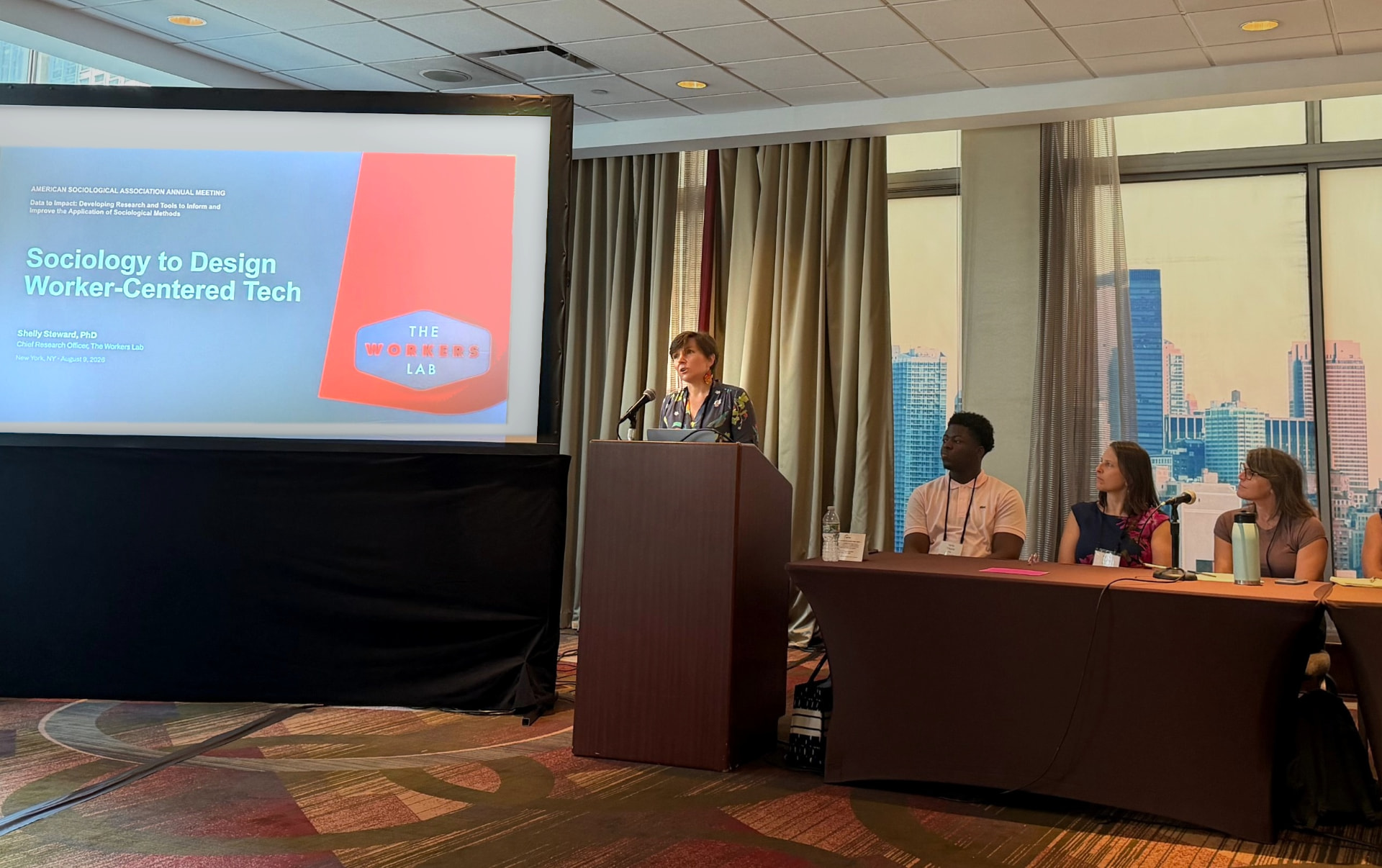
At The Workers Lab, we use research not just to learn about workers, but to empower them as leaders for change. This summer, we shared our approach with other researchers at the American Sociological Association Annual Meeting, held August 7-11 in New York City. The meeting, bringing together more than 5,000 sociologists from across North America, centered on the theme of “Disrupting the Status Quo: Putting Sociologists to Work for a More Equitable Society." The Workers Lab team contributed to this theme across three sessions.
Research to Build Solidarity
On a panel on public sociology, we shared our participatory process and emerging findings on how our approach can build community among participant researchers. Across a range of projects, hundreds of workers have joined us as paid research partners, shaping questions, analyzing findings, and co-authoring reports. Seventy-two percent have told us they felt more connected to others as a result of participating in a project, illustrating how research itself can become a space where workers see that their individual challenges are shared and spark solidarity.
Using Tech to Scale Research
In a lightning talk, we showed how we are using our technology to scale our research approach, engaging more workers on their own terms. Attendees saw a short demo of Breakroom, our new platform that allows workers to share their experiences across worksites, turn isolated incidents into shared evidence, and understand their challenges as part of a wider movement.
Sharing What We’ve Learned
Finally, we co-led a workshop on how power plays out in research with ASA's Community for Community-Engaged Scholarship & Teaching. The session tackled tough questions about when participants should be paid, how to balance university and community expectations, and how to share decision-making and data ownership across a diverse participant base. Attendees applied the conversation to their own work, and each committed to concrete changes to make their research more collaborative.
Learning Together
The thread running through all three sessions is the idea at the core of our research approach: the people closest to a problem should be the ones designing solutions. As we continue to learn from our process, we welcome opportunities like this to talk to other researchers and share our approach.
Interested in bringing participatory methods into your own work, or partnering with our research team on a project? Get in touch. We'd love to hear from you.